



Languages, A1 to C2, for the whole family
Eleven languages,one family price.
French, Italian, Spanish, German, Greek, Indonesian, Japanese, Korean, Mandarin, Western Armenian and Gujarati: each in six levels from A1 to C2, for children and for adults on one family subscription. Short lessons on a path, grammar in one card, a story at the end of every unit, and words that come back just before they are forgotten.
7-day free trial, then A$9.99 a month per family. Prices include GST. Renews monthly until you cancel. Cancel online any time.

11
languages
6
levels each, A1 to C2
3,400+
lessons
13,000+
words taught
48,000+
exercises
12
kinds of practice
A souvenir for every language
Finish a level and a souvenir from that country is yours.
Each language has its own 3D souvenir and its own animal friend. A learner earns the souvenir by finishing every lesson of one level, and it goes on their shelf. They are earned, never sold.


FrenchFrançais
Macaron stack
A1 to C2 · 749 lessons


ItalianItaliano
Gelato
A1 to C2 · 865 lessons


SpanishEspañol
Fan
A1 to C2 · 844 lessons


GermanDeutsch
Cuckoo clock
A1 to C2 · 666 lessons


GreekΕλληνικά
Amphora
A1 to C2 · 700 lessons


IndonesianBahasa Indonesia
Gamelan gong
A1 to C2 · 753 lessons


Japanese日本語
Temari ball
A1 to C2 · 979 lessons


Korean한국어
Norigae
A1 to C2 · 629 lessons


Mandarin中文
Red lantern
A1 to C2 · 749 lessons


Western ArmenianՀայերէն
Pomegranate
A1 to C2 · 677 lessons


Gujaratiગુજરાતી
Mirror-work pot
A1 to C2 · 704 lessons
Not sure which one?
Try a first lesson in any of them, with no sign-up.
Try a free lesson
11 languages, six levels each, for children and adults. Souvenirs are earned, never sold.
Try it now
Try a first lesson in any language, no sign-up.
Choose a language. One short lesson, no account, nothing saved. It takes about two minutes.
A path, not a pile
Each level is a map, and the next lesson opens when the last is done.
Each level is a map of units and lessons. The next lesson opens when the one before is done.
- Start in the right place. A short placement check suggests where to begin, and a learner can move between levels.
- A reason to come back. A daily goal, a streak and points for each lesson keep learners coming back.
- Its own script first. Greek starts with its alphabet, Korean with Hangeul, Japanese with hiragana and katakana, Mandarin with pinyin and the four tones, and Armenian and Gujarati with their own scripts. Readings switch on and off.
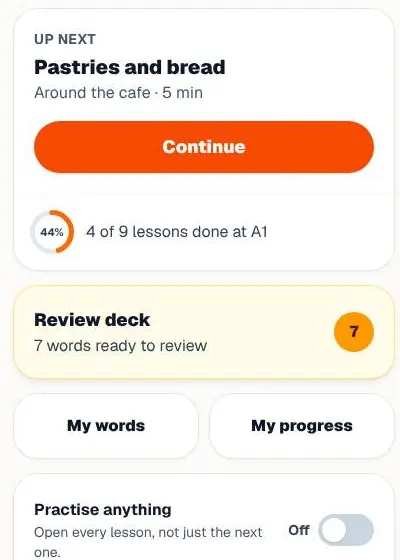
The French course path and the next lesson. Screens show a made-up family.
How a lesson works
New words are taught before they are asked.
New words arrive a few at a time, each one shown and heard before any question asks for it.
- Marking that explains. Typed answers forgive a missed accent and say which one, and a near miss is told what slipped.
- Grammar in one card. Each grammar skill opens with a short tip: one idea in plain words, with examples from the lesson.
- A story to finish each unit. Every unit ends with a short story or conversation built from its words, with questions on what happened.
- Mistakes come back. A question answered wrongly returns before the lesson ends, and the word goes to the front of the review deck.
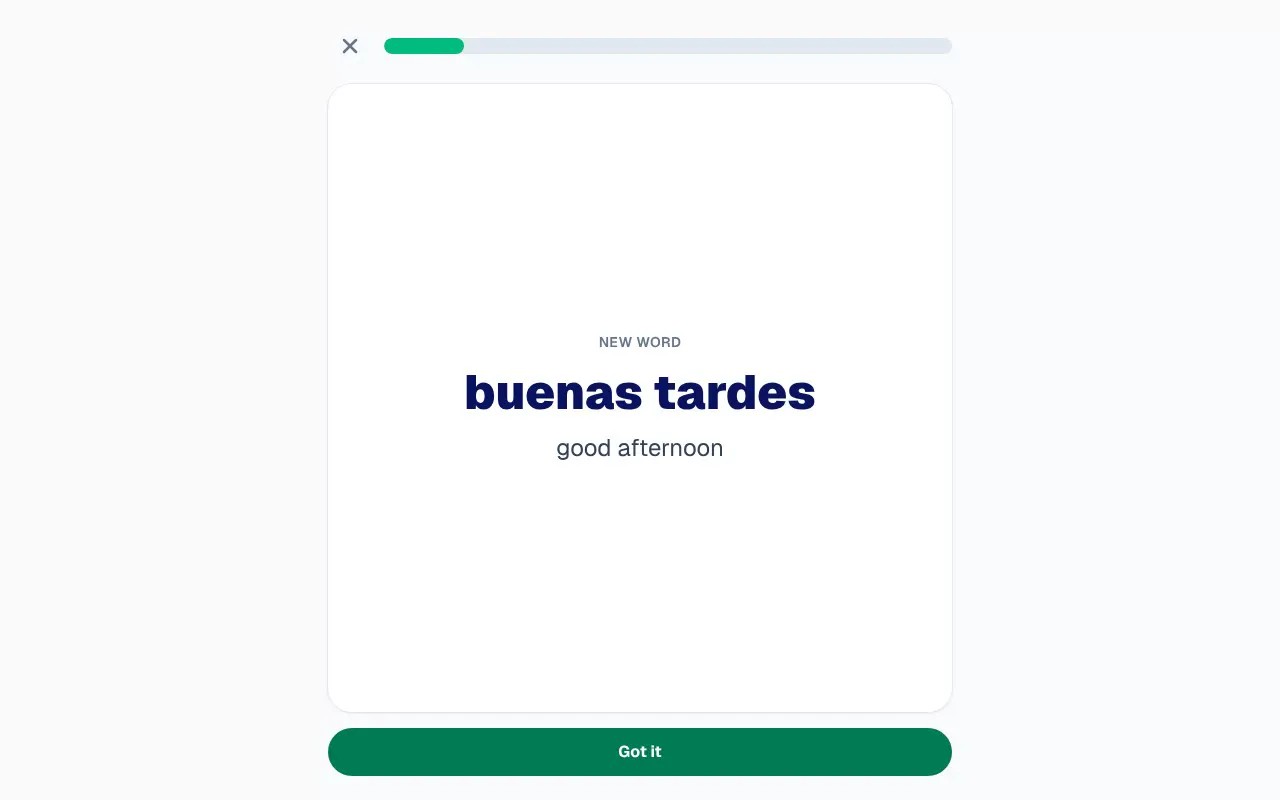
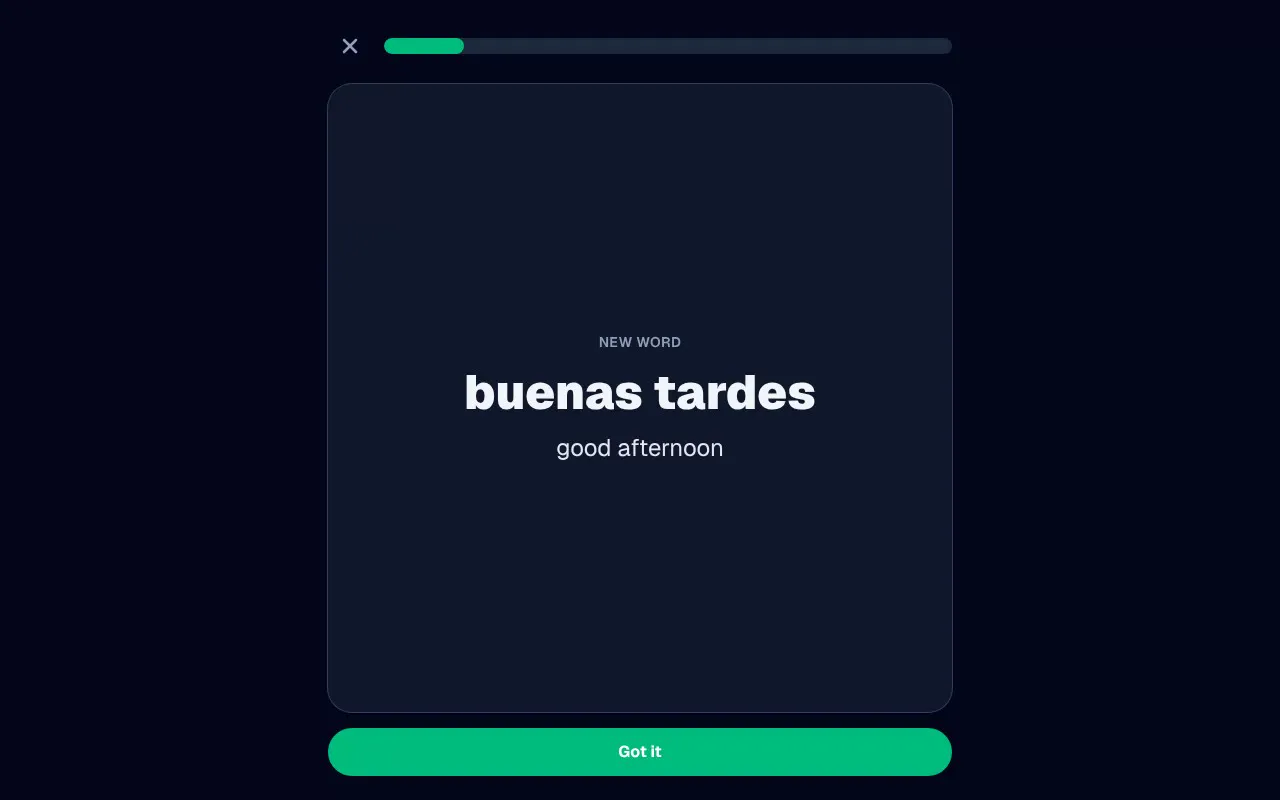
Write this in Spanish
goodbye
Correct, but watch the accents
Watch the accents: adiós, not adios.
Listen
What did you hear?
New word
hola
hello
New word
buenos días
good morning
New word
buenas tardes
good afternoon
New word
adiós
goodbye

Practice
Twelve kinds of practice in every lesson.
- New word
- What it means
- Write it
- Listen
- Build the sentence
- Match pairs
- Fill the gap
- Reading
- Script
- Dictation
- Speaking
- Dialogue
Remembering
Words come back just before they are forgotten.
Every word learned joins a review deck that brings it back just before it would be forgotten.
- Speak and listen back. In speaking steps your child hears the phrase, records themselves and plays it back to compare. Nothing is uploaded or kept, and the recording is gone when the step ends. XLingo does not score pronunciation.
- My words lists every word with how well it is known: new, getting there or strong.
- My progress shows the week's practice, the day streak and the words met.
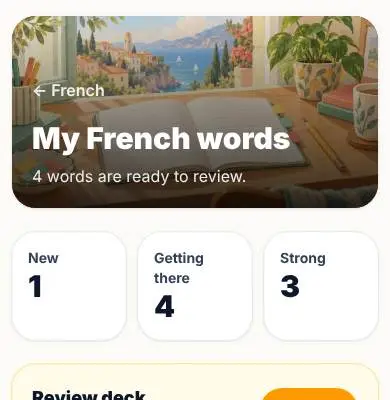
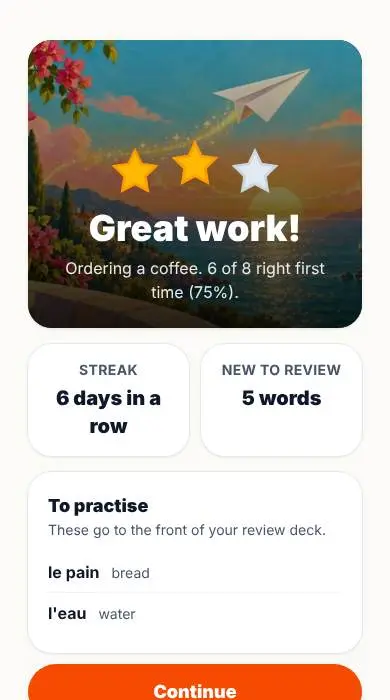
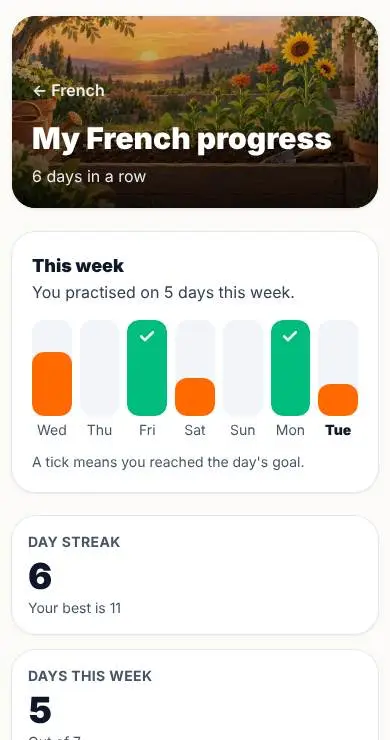
My words, the end of a lesson and My progress.
For parents
See the week. Keep it calm and private.
One price, the whole family
Every child and every adult who wants to learn is covered, each with their own level and review deck in each language.
See each child's week
A parent page shows every child's level, words learned, words due for review and the days they practised this week.
Five minutes at a time
Lessons take about five minutes, so a language fits between school and dinner.
Calm and private
No advertising and no upgrade prompts where a child can see them. A speaking recording never leaves the device.
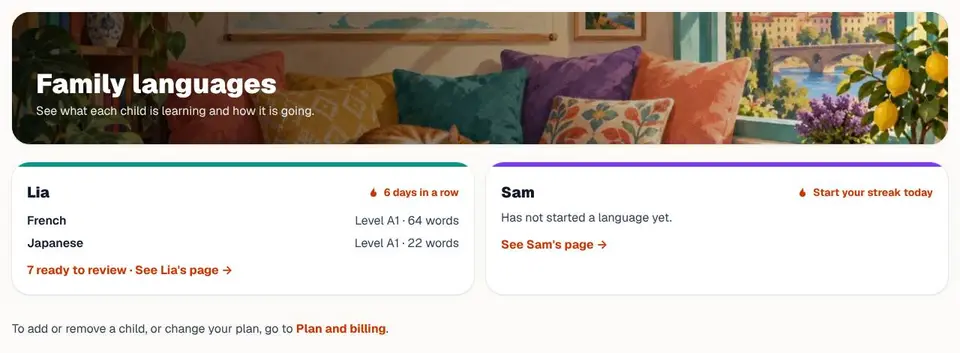
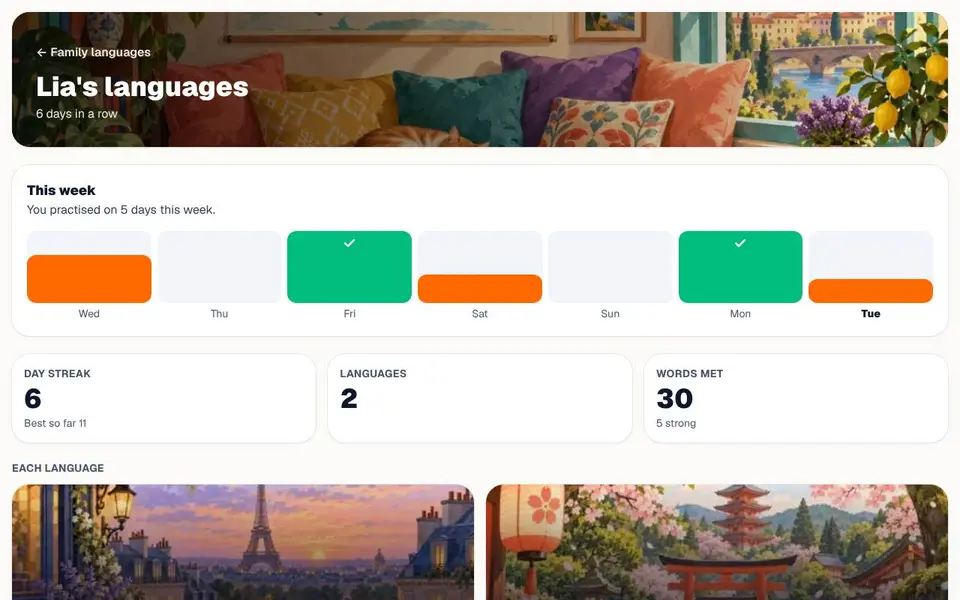
The parent's Family languages page. Screens show a made-up family.
The whole family
One price. Children and adults both learn.
One subscription, everyone learns
Every child in your family and every adult who wants to learn for themselves is covered by the one price.
Each person has their own place
Everyone keeps their own level, words and review deck in each language, so a parent and a child can learn the same language at their own pace.
Children and adults, each at home
Children learn on their own screens, with nothing sold to them. Parents learn for themselves on their own pages, and can see where each child is.


How it works
From sign-up to the first lesson in a minute.
Step 1
Sign up
A parent makes the account and adds the children. Adults who want to learn join the same account.
Step 2
7-day free trial
A card is needed to start. Nothing is charged for 7 days, and we email you before the trial ends.
Step 3
Start at A1, or where it suggests
A short placement check suggests where to begin in each language.
Step 4
Cancel online any time
From your account page, in as few steps as it took to join.

Straight answers
What XLingo is, and what it is not.
Practice and course work, not a promise of fluency
How far a learner goes depends on the time they spend. XLingo does not promise fluency, a grade or a level by a date.
Speaking is listen, record and play back
A learner hears a phrase, records themselves and compares. Nothing is uploaded or kept, and XLingo does not score pronunciation.
Some devices have no voice for a language
Western Armenian has no voice on most devices, so its lessons skip listening rather than read it in the wrong accent.
Written by our team, not yet checked by native speakers at every level
Written by our team. The newest levels have not yet been reviewed by native speakers.
Not a school course
XLingo is not tied to a school syllabus and makes no promise about marks in a school or HSC language.
Questions
What parents ask.
How does the price work?
It is one price for the whole family: A$9.99 a month, or A$99.90 a year, which is two months free. You start with a 7-day free trial, and a card is needed to begin. After the trial it renews each month (or each year) until you cancel, and we email you before the trial ends. Prices include GST.
Which languages?
French, Italian, Spanish, German, Greek, Indonesian, Japanese, Korean, Mandarin, Western Armenian and Gujarati.
Can adults learn too?
Yes. One family subscription covers every child and every adult who wants to learn for themselves, each with their own level and review deck.
What are the souvenirs?
Each language has a 3D souvenir, such as a stack of macarons for French or a temari ball for Japanese. A learner earns it by finishing every lesson of one level of that language, and it goes on their shelf. Souvenirs are earned, never sold.
How does speaking practice work?
The learner hears the phrase, records themselves and plays it back to compare. Nothing is uploaded or kept, and XLingo does not score pronunciation.
A little every day in a new language.
Start with the first words today.
XLingo in short
XLingo is an online language subscription for the whole family, adults too: eleven languages, each in six levels from A1 to C2, with five-minute lessons, grammar cards, a story at the end of every unit and a souvenir to earn in each language. One subscription covers every child and every parent: A$9.99 a month per family (or A$99.90 a year), after a 7-day free trial (a card is needed to start). A free first lesson in any language needs no sign-up.
Questions parents ask
- How does the price work?
- It is one price for the whole family: A$9.99 a month, or A$99.90 a year, which is two months free. You start with a 7-day free trial, and a card is needed to begin. After the trial it renews each month (or each year) until you cancel, and we email you before the trial ends. Prices include GST.
- Which languages?
- French, Italian, Spanish, German, Greek, Indonesian, Japanese, Korean, Mandarin, Western Armenian and Gujarati.
- What do A1 to C2 mean?
- They are the six levels of the Common European Framework, from beginner (A1) to the most advanced (C2). Most learners start at A1, or wherever the placement check suggests.
- Can adults learn too?
- Yes. One family subscription covers every child and every adult who wants to learn for themselves, each with their own level and review deck.
- What are the souvenirs?
- Each language has a 3D souvenir, such as a stack of macarons for French or a temari ball for Japanese. A learner earns it by finishing every lesson of one level of that language, and it goes on their shelf. Souvenirs are earned, never sold.
- How does speaking practice work?
- The learner hears the phrase, records themselves and plays it back to compare. Nothing is uploaded or kept, and XLingo does not score pronunciation.
More about XLingo: Pricing, FAQ.
XLingo is made by XTutio, an Australian software company that builds software for tutoring centres and families. Learn more at xtutio.com. More from XTutio.